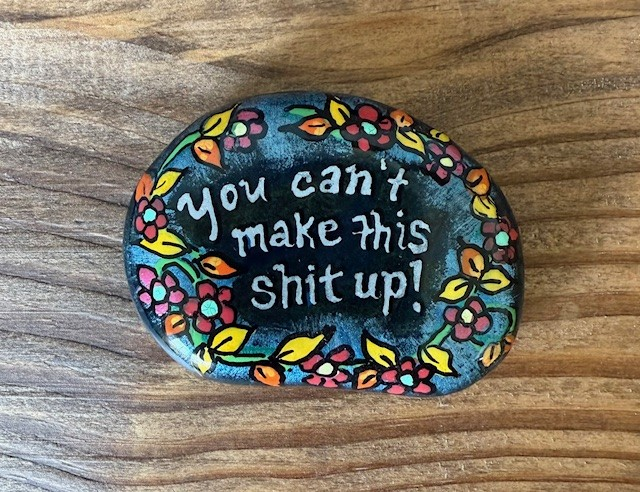

Why are people so annyoing?

I was at a bar, waiting for my date to arrive, and he was late. I looked at my watch and decided five minutes wasn’t so late; I could wait a little longer. This was before cellphones, so I couldn’t text him to see where he was. Five minutes became ten, which became fifteen. I wasn’t worried that something had happened to him, I was angry that he valued me and my time so little. I decided to wait just a little longer and then I’d leave. Which I did. And I was fuming.

These days, everyone has a cellphone, and I still get angry when someone is late. I’m glad I’m not a worrier, concerned that the person who’s late was in an accident. But I sometimes wish I were the kind of person who said, Oh, that’s just Emma! She always runs a little behind.

How about you? How do you feel when someone cuts you off in traffic or refuses to let you merge? What does the voice in your head say when a server or salesperson is rude to you? How do you react when someone interrupts you or gives you unsolicited advice?

We can’t control other people’s behavior. We can only control how we react to them. And I think we forget that. I know I do, especially in the moment.

From a spiritual perspective, irritation can be an important teacher. It’s impressive when we’re able to remain centered and calm when we’re uncomfortable. It’s easy to be Zen when everything is to our liking, but how often does that happen? There will always be people and circumstances outside our control.

The goal of spiritual growth is not to learn to control our environment. That’s an ego-driven goal. Sure, we can have some say in how our reality unfolds. There are plenty of spiritual tricks for doing just that. But when we choose to react to irritation with detachment, calm, or even compassion, we can see our progress. Mastering our internal reality means we’ve become masters of our lives.

Fortunately, life offers an abundance of opportunities to practice and cultivate patience, tolerance, and acceptance. Which means we have plenty of chances to grow.


Do you find it hard to say no?

“I feel a sore throat or tonsilitis,” I say week after week in my Wednesday Facebook Live. “Someone has fifth chakra issues.”

What the hell does that mean?

It means that someone watching my Live is afraid of speaking up. They worry about being judged. They find it hard to say no or to express their needs. Sometimes it means that they have something that needs to be said, something they’ve been holding onto for a long time.

If you have (or had) chronic strep throat or tonsillitis, or frequently feel like there’s a lump in your throat, or if you carry tension in your neck or jaw, you most likely need to do some work on your fifth chakra. Other signs would be thyroid issues, grinding your teeth or clenching your jaw, or frequent stiff necks. These are your body’s ways of saying it wants to be heard. That it wants you to be heard.

The fifth chakra is located in the throat area. It’s associated with the color blue. When balanced, it allows for honest and confident communication. It governs truth, authenticity, and self-expression.

Fortunately, it’s relatively easy to bring this chakra back into alignment.

The easiest thing to do is sing, especially emotional songs. Find some Adele and belt it out. If there’s a song that makes you cry, sing that.

Chanting is also good. Or even screaming. Try it. Scream for a minute straight every day for a week.

You can journal to get out the unspoken words. Or write letters that you won’t send. Writing will change your thoughts from a swirling cloud that looks like the Tasmanian Devil cartoon, to something linear that is easier to dissect and deal with. Or get a stuffed animal you can put on your car’s dashboard that you can talk things through with when you’re driving alone.

I always recommend working with affirmations. A good one for your fifth chakra is: It’s easy for me to speak my truth. I let my voice me heard. Or It is safe for me to express myself. If your brain tells you you’re a fat liar when you use an affirmation, change it to a question. Why is it so easy for me to speak my truth and let my voice be heard?

And consider coming to the Workshop at Three Waters Reserve in Brodhead, Wisconsin. I’m going to bring my singing bowl and do some sound healing, which is especially powerful for the fifth chakra.

Getting memories from the future

‘Gut Feelings’ Are Memories from the Future, Scientists Say.
Even the CIA has publicly released data on the psychic phenomenon.”

I saw this headline and was intrigued. Unfortunately, the article was behind a paywall.

This news doesn’t surprise me. What does surprise me is that it took scientists (and the CIA) so long to investigate it.

Five or six years ago, out of the blue, I decided to no longer be a wedding officiant. I had been marrying couples for about twenty years, and it was time for a change. I still enjoyed everything about my job, but something inside me was telling me it was time to pivot. I contacted the websites I advertised on and cancelled my accounts. One of them tried their damnedest to retain my business. They offered me steeper and steeper discounts. I almost relented but then listened to my gut.

Three months later, the pandemic hit. If I had spent money on advertising, it would have been wasted.

I’m sure you have a similar story. A job you quit before the company went under. A trip you didn’t take to a city that ended up having a mass shooting while you would have been there. The alternate route that struck your fancy—and kept you from a huge traffic jam.

Or maybe you’ve had the reverse, a gut instinct you didn’t listen to. Hopefully, whatever happened taught you to listen the next time.

What scientists are studying is whether gut feelings are a form of precognition. That is, the ability to perceive events before they occur.

From the work I do clearing energy, I know that time is not linear. I can access information from the past, the present, and the future. So can you.

There is something called the gut-brain axis, a network of nerves that connects your brain and your gut. Those butterflies in your stomach or upset tummy when you’re nervous are part of your gastrointestinal tract sending signals to your central nervous system.

All this to say, trust those gut feelings.

And P.S. It’s about time science looked into it.

I’ll bet you’re braver than you think

“Life should not be a journey to the grave with the intention of arriving safely in a pretty and well-preserved body, but rather to skid in broadside in a cloud of smoke, thoroughly used up, totally worn out, and loudly proclaiming, Wow! What a Ride!”
                                            –Hunter S. Thompson

A friend of mine posted this on Facebook recently. She remarked that she’s not physically adventurous or an exciting risk-taker.

I was reminded of this today when I was talking with one of my granddaughters. She’s a high-school freshman and is taking advanced weightlifting. She’s the only girl in that class. And she said she didn’t think freshmen were allowed to be in the advanced level.

I told my granddaughter that I was proud of her. Taking a class where you’re both the youngest and the only girl is scary. It’s a risk.

But every time we take a risk, we push the boundaries of what we thought we were capable of. We prove to ourselves that we’re made of strong stuff. We open the door to the next challenge, which we’ll face with a little less fear because we know we could handle the previous test.

We don’t have to leap out of an airplane or bungee jump over a river to “loudly proclaim, Wow! What a Ride!”

Take a moment to think of something you’ve done that tested your safe boundaries.

Me? I graduated from high school early and moved to Paris to study at the Sorbonne. I didn’t speak much French and didn’t know if I’d even be accepted by that venerable institution. But that was ages ago. More recently, I dissolved the corporation I had run for twenty years and started on a new career path: energy clearing. That was a scary move.

Small things count as well. Maybe you stood up for yourself. Or you advocated for someone. Perhaps you allowed yourself to tell the truth when it was difficult or uncomfortable. It might even have been saying no to someone.

Courage comes in many forms, not just physical. There are emotional, moral, and social acts of derring-do.

How can you experience something unfamiliar this week?

P.S. I can’t even look at the photo of the woman on that swing without raising my blood pressure to an unhealthy level!

Practical magic

Time is an illusion. Lunchtime, doubly so.
                –Ford Prefect, from Douglas Adams’s Hitchhiker’s Guide to the Galaxy

When one of my granddaughters was an infant and the other a toddler, I had them a few times a week for fourteen-hour days. There were times when I felt like the day was never going to end. Time absolutely dragged.

Conversely, when I’m writing or crafting, I completely lose track of time.

If only there were a way to speed time up when we’re bored or overwhelmed and to slow it down when we’re having fun.

Guess what—there is.

I just read an interesting study where participants engaged in various activities. They had a clock that was either accurate or artificially sped up. Those with the sped-up times believed the activity was more enjoyable because they were tricked into thinking time had flown by.

Time flies when you’re having fun, after all.

Here’s a thought experiment for you. Think of a time you went to a theme park. The wait for the ride seemed endless, didn’t it? Especially compared to the time on the ride. But which do you remember more of? Most likely, it’s the ride. You remember how fun and thrilling it was. And you probably remember the amount of time the ride lasted incorrectly, thinking it was longer than it was because you were completely absorbed in the experience.

If you want to slow down time, pay attention to it. Savor what you’re doing. Bring your attention to the moment. See everything from the outside with fresh eyes.

If you want to speed up time, don’t look at the clock. That’s the worst thing you can do. If you’re stuck in traffic, notice the trees on the side of the rode. In an airport, you can people-watch. If time is standing still in a boring meeting, doodle or play buzzword bingo. In other words, find a fun distraction.

If the years seem to be flying by, it’s due to something called memory consolidation. You need new experiences so that your brain has more to process. Go somewhere new. Learn something new. Read a book from a different genre than your usual one.

When you find you can manipulate time, you’ll feel the power and magic that were in you all along.

Is the glass half full?

Is the glass half full or half empty?

How you answer that question is supposed to be the predictor of whether you’re an optimist or a pessimist. Do you have a sunny view of the future? Or do you constantly imagine and plan for catastrophes?

I promised both of my granddaughters that if they got good grades, I’d take them anywhere they wanted to go. One of them wants to go to Egypt. Cool, right? I looked into it, found a tour that looks perfect, presented it to my daughter who said, “It sounds dangerous. Maybe take her to California.” Guess who’s the Tigger and who’s the Eeyore.

Now researchers have come up with a new way to tell if you’re a Tigger or an Eeyore. They’ve found that people with an upbeat outlook have similar patterns of brain activity when they think about the future.

“Optimists seem to use a shared neural framework for organizing thoughts about the future, which likely reflects a similar style of mental processing rather than identical ideas,” says Kuniaki Yanagisawa, an author of the research from Japan’s Kobe University.

He went on to say that what the study found was that “the foundation of [optimists’] social success might be this shared reality. It’s not just about having a positive attitude; it’s that their brains are literally on the same wavelength, which may allow for a deeper, more intuitive kind of connection.”

You’ve heard the line from Leo Tolstoy’s Anna KareninaHappy families are all alike; each unhappy family is unhappy in its own way, right? It seems that this is true for more than just families. Based on the brain scans, optimistic people think similarly. Pessimists each imagine something different going wrong. They imagine different scenarios and different degrees of misery.

What’s important to note is that optimism isn’t a form of reality distortion or irrationality because what the optimist sees is how a future event will impact us. It doesn’t ignore the presence of challenges, instead it motivates the individual to pursue goals.

If you tend to see calamity looming, try picturing a positive outcome in detail. See it as feasible and desirable. That changes the situation into something to value and work for, ultimately making it something you’re more likely to achieve.

Be the magic you want to see in the world

When you go to the beach, do you take a small bucket, scoop out some water, take it back to your towel, and dip your foot in it? Of course you don’t.

If you won a lottery jackpot of $300,000,000, would you say, “I only want $6,000 of it.”? Of course you wouldn’t. Why would you settle for less than all of it?

Where in your life are you settling for less right now?

A friend posted on Facebook yesterday:
You have an endless supply of love. Spread that shit around like manure and watch all the beauty that grows.

The Universe is infinite. You can have it all.  But be careful.

Just as there is an endless supply of love, there can be endless rage. There is an infinite amount of money, but also infinite poverty.

Your intentions matter.

Small acts of kindness can cascade and multiply. They can have a huge impact. So can a small act of rudeness.

If you want more love, be more loving. Not from neediness, but because loving feels good. If you want money, be generous. Again, altruistically, not with an ulterior motive.

Pay someone a genuine compliment. Hold a door open for someone. Thank someone for holding the door open for you. Leave a generous tip. Paint rocks and leave them for others to find. Donate blood. Take your old towels to an animal shelter. Give to a worthy cause. Volunteer.

Start the ripple of positivity. Get the ball rolling. And watch (with gratitude) all the good things that come your way.

Be the magic you want to see in the world.

What do you want to do before you die?

There’s a question I often ask my clients: What do you want to do?
It’s actually three questions.

  • What do you want to do?
  • What do you want to experience?
  • What do you want to contribute?

And the problem most people have answering those questions is that they don’t think big. They consider what’s realistic, what they can afford, or what’s safe.

Who wants a small dream?

“If I had millions of dollars, my family would expect me to share it with them,” one client said to me. I shook my head in disbelief. That’s a boundary issue. You can share or not share with whoever you want. It’s your money.

Or “I can’t write a book—I don’t have time to go on a book tour.” Do you want to write a book? Or do you want to have a best-seller published? Writing is creative. Selling is entrepreneurial. That dream needs refinement. Is it the writing, the money, or the fame?

Why do we insist on putting limits on our dreams?

What would you love to do? If you had infinite potential and unlimited resources, what would absolutely light you up?

You don’t know how to make that happen just yet. You simply have to plant the seed. Put the idea out into the Universe and then keep your eyes and ears open for opportunities. The Universe is infinite and magical. Trust it.

You define those three questions. You can say you want to own a Lamborghini, swim in the Dead Sea, and give a TED talk. Or maybe you want to get a master’s degree in chemical engineering, become an expert distiller, and sell a new and unique spirit internationally. Or maybe, like my sister-in-law, you want to take your children to visit every country in the world. That covers all three.

What do you want to do? Dream big. Make a list. Put the idea out there. What do you have to lose?

Why do we die when we do?

I was recently asked why I thought people die when they do.

It’s a thought-provoking question.

I believe we make soul contracts with people that last through many lifetimes. We have lessons to learn and lessons to teach these people. We cycle through various relationships with them as we revisit what we’ve learned and what we still need to learn.

For example, in this life, I have parents (obviously), siblings, a husband, an ex-husband, children, and grandchildren.

In a past life, I’m pretty sure my son Max was one of my parents. Since he was a toddler, he has always tried to take care of me, has scolded me, and treated me like he’s the parent.

I know my ex and I were married in past lifetimes and we’ll probably be married again at least one more time. Some of our soul issues were resolved in this life, but I’m guessing we still have more to teach each other. In other lives, we may have been siblings, or cousins, or even coworkers.

You get the picture.

We all know of examples of spouses dying close together. We say it’s of a broken heart, and that may be true. But it may also be that to be married in the next life, they need to be born close to one another. And look at Debbie Reynolds dying one day after her daughter Carrie Fisher. Yes, she missed her. But my bet is that they have another life coming up that needs them both to be similar ages.

I asked my friend Jennifer for her take on it. She agreed and added that there are times when the person left living still has things they’re meant to experience before it’s their time to transition. It could be anything from being an important part of a child or grandchild’s life, to learning more about love or patience, or resilience.

Of course, we won’t know what happens after we die until we get there. But if you’d like to learn more about what happens immediately after we die, I highly recommend Eben Alexander’s Proof of Heaven: A Neurosurgeon’s Journey into the Afterlife. It’s a fascinating read from scientist who experienced death and lived to write about it.

Do you hear voices?

“She hears voices,” a friend reported to me, trying to convince me that someone she knew was crazy.

“So?” I asked. “Don’t you?”

She shrugged. “Maybe. Yeah. Sometimes.”

Why does that seem so strange to people?

Have you ever smelled the perfume of a loved one who’s dead? Do you consider that a sign of mental illness?

We have no trouble feeling comforted by scents. And many people see things like pennies, cardinals, or butterflies (even moths) and feel they’re signs from someone who has passed over.

Why is it that smells and signs reassure us, yet words freak us out?

Our dead loved ones are with us, ready to offer support, consolation, and wisdom. Sometimes it comes without our asking, but we can always request their help. Why is it that we prefer it to come in the language of signs and symbols rather than direct words?

I recently read an interesting study about the difference between those of us who wig out when we hear voices and those who don’t. People who can control when they hear voices and are able to tap into them when they decide to, don’t find the voices scary. This element of control makes all the difference.

Think of it as a radio. You’re in charge. Sure, if you’re shopping or at the dentist, there might be music you didn’t choose (how many fillings have I gotten with classic rock kicking my discomfort up a notch?). But setting firm boundaries with the voices puts you in charge.

When I have my weekly Facebook Live each Wednesday at 9:00 a.m. CT, I invite people’s ancestors in. The radio is on, so to speak. Fifteen minutes later, when I’m done, I send them on their way. Radio off. If I ask one of my ancestors for an answer to a problem I’m having, I’m open to hearing their wisdom—and that’s all I’m open to. No chit-chat, please.

Occasionally, there will be a pushy person on the other side who wants to talk now. I tell them to wait until I’m working. Just as you would if someone from your job called to annoy you at home.

So, invite your ancestors in. Ask them for whatever you need. They love you and would love to help. Be willing to hear what they have to say. And then, when you’ve gotten your answer, thank them and send them off until next time.

Posts navigation

1 2 3 4 5 6 7 26 27 28
Scroll to top