
Are hauntings real?

I used to work in a building that was haunted.

There were six treatment rooms for acupuncture, massage, and reiki. The energy in one of the rooms was so scary that none of the therapists would work in it even if it were the only room available. It was said that there was a portal to the other side in one of the walls.

It was my job to go in each evening and try to close the portal and clear the energy. I don’t know if this was because I was the newest employee, the last one out each night, or because I was the least scared–and I found it plenty creepy.

One night, as I was setting the alarm, I bumped into someone. I said excuse me and then realized I was the only person in the building. Well, the only living person. I hurried out to my car, completely spooked.

A study recently published in Frontiers in Behavioral Neuroscience says that the unsettling feeling we attribute to the presence of ghosts may be caused by acoustic frequencies below 20 hertz, known as infrasound.

Humans can’t hear infrasound, but it raises our stress level and gives us that creepy feeling. It increases cortisol and irritability. It’s more common in older buildings with vibrating pipes and ventilation systems, as well as buildings near subway systems and traffic.

We don’t hear these low frequencies, but we do respond to them. While this may provide a scientific explanation for what we experience as haunting, I’m not convinced that this is the only thing we’re responding to. As with most things, I believe the truth lies somewhere in the middle.

After all, how does a low frequency in an old building explain my bumping into someone after everyone else had gone home?

Go ahead, laugh at yourself

My word for 2026 is silly. I want to be less of a serious goose. I’m trying.

We had out-of-town guests stay with us recently. One night, we went into Chicago, had lunch at Eataly, went to the Chicago Magic Lounge, and stayed overnight in a hotel. I had leftovers from lunch, but the mini fridge in our room didn’t work. Would that pork cutlet still be good in the morning? The germophobes would say no. The frugal faction would say it was worth a shot.

We got back home the next day. We were having cocktails in the backyard and one of our friends asked, “By the way, whatever happened to your leftovers?”

“In my suitcase,” I said, and burst out laughing. So much for my excellent memory.

New research suggests that if you can find humor in the moment, if you can laugh at yourself, you’ll be seen as warmer, more relatable, and surprisingly, more competent. Who knew?

We all do things that are embarrassing. We spill our water at a restaurant. We mistakenly wave at a stranger, thinking we know her. We slip on the ice and dramatically windmill our arms before landing on our butt. We can cringe and still be red-faced five minutes (five hours?) later. Or we can laugh at ourselves.

Part of the study (published in February 2026 in the Journal of Personality and Social Psychology) found that people observing thought the embarrassed person’s reaction was out of proportion to what is seen as an everyday blunder. Laughing at oneself showed the person understood the mistake was trivial.

Of course, it’s all about proportion. Laughing at ourselves when we trip and bump into a stranger who then falls and breaks their arm isn’t appropriate.

But for trivial things where we’re the only victim? Remember that most people judge our mistakes less harshly than we judge ourselves. Shifting the dynamic by laughing allows other people to laugh with you.

And that’s a good thing. Especially if you want to be less of a serious goose.

Are you for or against?

There’s so much in the news lately to be upset about. Sometimes, it feels like there’s more sad news than good.

The way we view politics and world affairs can have a profound effect on both our energy and, by extension, the energy of the world. Our perspective matters.

For example, we can be against war. Or we can be for peace. Directing our energy and actions into promoting peace is vastly different than speaking out against war.

It seems like two separate ways of expressing the same thing, but constructive intent is powerful. When we support a cause, a movement, or even an idea, we contribute to optimism and optimism fuels affirmative change.

To be against something is easy. It’s usually just words spoken in opposition. It’s passive. And it typically sounds hateful.

To stand up for something can be difficult. It can feel exciting, but also scary. We might find that we have an idea that hits us on a soul level. We may want to get others involved because we’ve been told that the actions of one person are rarely enough.

But the thoughts we adopt when we are willing to stand up for what we believe have rippling effects. Positivity breeds more positivity. Promoting our values fosters change.

Even those of us who are more optimistic Tiggers than gloomy Eeyores can start to feel down when we watch, listen to, or read the news. But if we can take a moment to tune in to how we feel and change our attitude from against to for, we start to raise our vibration. And that’s good for everyone.

How rich do you want to be? The sky’s the limit

Do you want to be rich? Wealthy? How rich or wealthy?

Have you tried manifesting financial abundance, but the money never seems to flood in the way you’d like it to?

It’s time to examine (or re-examine) your limiting beliefs, those subconscious and ingrained thoughts that are keeping you stuck where you are financially.

If you feel you’ve already done this, stay with me. Skip ahead a few paragraphs.

Take a look at these statements:

  • Money is hard to get.
  • The rich get richer.
  • Wanting money is selfish.
  • Only greedy people want more money.
  • Money determines my success.
  • Having lots of money would change me.
  • If I were rich, people would ask me to give them some (and they’d spend it on stupid stuff).
  • I need to be frugal to have more.

Sit with each one for a couple of seconds. Do you feel it in your body? Where? If you agree with the statement, where do you think it came from? Is it an inherited belief? Or did it come from somewhere else?

If you looked at those statements and said, “Yeah, yeah, Toni. I’ve already done that work,” then why are you still not receiving the abundance you desire?
Try this exercise.

  • How do you feel about politicians? Distrustful? Why? Do you feel they are selfish and only care about special interests that make them richer or more powerful?
  • How do you feel about celebrities? Do they deserve the amount of wealth they have? Does their money make them out of touch with reality? Should they be donating more to charities?

If any part of your dislike of a politician (or politicians in general) involves their money, examine it to find your limiting belief. Same with CEOs, movie stars, comedians (Jerry Seinfeld’s net worth is over $900M), and TV personalities (Oprah’s is $3.2B), athletes (Michael Jordan’s is over $3.3B). Your mind may tell you that what comes up is true (“No one should have that much money. They should donate it and help the world.”), but it’s not fact. It’s a belief.

This is deep work. I can write 350 words that you read in five minutes or less. The work is going to take longer. But if abundance is what you truly desire, the work is worth it.

Remember, abundance is unlimited. Your having as much as you want doesn’t keep anyone else from having as much as they want. Their limiting beliefs do that.

We can never be sure how we’ll react

I’ve been a funeral celebrant for over twenty years. I’ve led memorial services in people’s homes, in unusual venues like the Cheney Mansion in Oak Park, Illinois, and the Morton Arboretum, as well as in funeral homes. The very first service was for my aunt’s husband. It was at the side of a lake in Florida.

Now that aunt is dead. I keep waiting for it to hit me. We were ten years apart and grew up like sisters.

There’s no service planned for her. My cousin and his wife had her cremated and will spread her ashes in the mountains in Arizona, a place she only lived for a few months.

I wonder how she would have liked to be remembered. To be honored.

When my husband and I set up our will and trust, we told our children to do whatever they wanted after we died, preferably whatever is least expensive. Have a service or don’t; we won’t care. We’ll be dead.

I do think that writing my own death notice would be fun.

Toni’s death was hastened by the abysmal condition of the Chicago Bears last season. She leaves behind her husband Chris, who she referred to as her “Little Pecorino,” her two children, who she tolerated through the years, and four grandchildren. Gianna was her favorite. As a wedding officiant, she married over five hundred couples and takes no responsibility for any divorces. At least she’s confident that her work as a funeral celebrant stuck. As a psychic, you’d think she’d have seen her death coming. In lieu of flowers, she asked that scratch-off tickets be handed out to strangers.

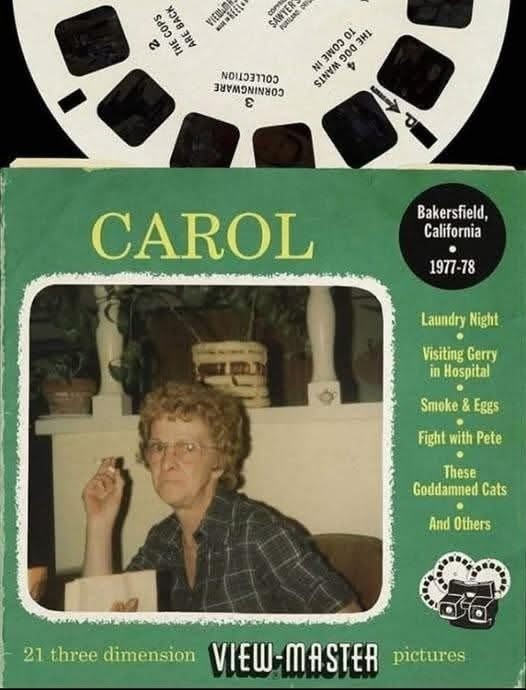
I also recently saw that someone had made View-Master reels of their mom. I’m pretty sure it was fake, but still. I think that would be a hoot. I even texted my kids, offering to set aside money for the viewers and to start gathering photos for the project.

All humor aside, it is important to honor our dead loved ones. Fewer and fewer people are having traditional funerals, instead opting for a “celebration of life” in a restaurant or bar. Without a service, it takes longer for the reality of death to set in.

Which is how I find myself not quite feeling like my aunt has died.

Stop (subtly) lying to yourself

I went to my forty-fifth high school class reunion a couple of years ago. All the men looked pretty much the same— gray hair and a little less of it, a little more weight, some wrinkles, and glasses. Thank God they were wearing name tags. The women, on the other hand, did not look alike. Hair color ranged from natural gray to dyed blond and brown. Some faces had a few wrinkles, some looked like you could, as my friend Cheryl said, bounce a nickel off them.

We tell ourselves and each other that we’re enough. That we’re worthy. How much of that are we believing when we’re constantly trying to look younger than we are?

Even if we don’t spend money on Botox or fillers, how many of us shell out money for expensive face creams, dark-spot correctors, retinol, and anything with hyaluronic acid or some other exotic ingredient. Does hemp really have stem cells?

I still write letters to a friend I met in college. Last year, she retired from a high-level position at the National Institutes of Health. She bikes at least a hundred miles a week. She’s happily married. She’s socially active. She has hobbies. She recently wrote that she’s going to start using a retinol cream.

I want to know why.

She’s not applying for a job. She’s not looking for a lover. Why does she feel she needs to try to stop time in its tracks?

What makes her, us, feel like we’re not perfect as we are?

We all know the answer to that. Television, movies, and society value youth, especially in women. We lose relevance faster than men. I’m at the age where medical professionals see my birth year and ask if I need help filling out forms online. They pause longer when speaking to me, as if I’m going to tell them a story about what my cat did that morning.

I don’t hear men my age reporting the same experiences.

If we truly are enough, if we are really worthy, if we are perfect as we are, it’s time to stop trying to be someone else, someone who looks twenty years younger.

It’s time we women stopped lying to ourselves about our worth, especially as we grow older.

Go ahead and eavesdrop

I was meditating by the Milwaukee River in Estabrook Park years ago. Two men walked by on the path just above me. They were gossiping and one of them said, “He’s as dumb as a bag of hammers. And I’m not talking about a particularly smart bag of hammers.”

As Thornton Wilder once said, “There’s nothing like eavesdropping to show you that the world outside your head is different from the world inside your head.”

We’re all so disconnected lately. I can’t talk to my husband when we’re on a plane or in an Uber because he has his AirPods in his ears. Some days I feel like I’m the only one who doesn’t have AirPods in my ears. Does anyone eavesdrop anymore?

Don’t get me wrong, there’s something to be said for not being forced to listen to two people having what seems like the world’s most boring conversation. On the other hand, we increase our capacity for empathy when we hear a parent trying to soothe a fussy child on a seven-hour flight. Or when we listen to two teenagers in the backseat who have forgotten that our ears are a few feet away.

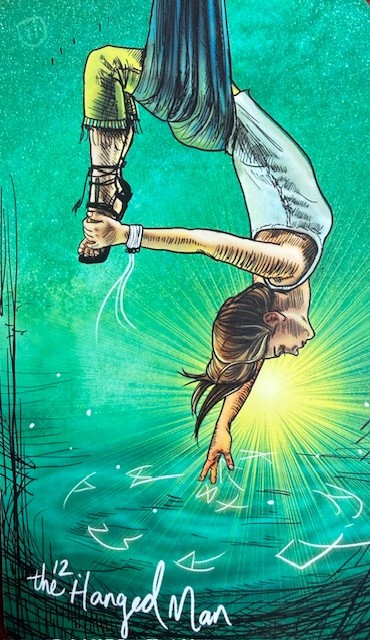
The Hanged Man tarot card is about getting a new perspective. The best way to do that is to realize that other people’s lives work differently than our own. They have different priorities, dreams, and intentions. We think we’ve honed the perfect system for paying bills, doing laundry, driving to work, or whatever it is. When we take the time to see that others also think they have a pretty good system, it gives us something to chew on.

I like to believe I’m efficient. I think I would have made an excellent efficiency engineer. My husband recently saw me put on my footwear and asked if I was human because I do the left foot’s sock and shoe, then the right foot’s sock and shoe. “Who does that?” he asked. A few months ago, I saw that he wets his toothbrush before putting on the toothpaste. Genius! Why hadn’t I ever thought of that?

Those are simplistic examples. But you get the picture. Pay attention. Listen. Watch. What if you adopted someone else’s point of view for a moment? How might that change your life?

Start your day by connecting with Spirit

I love mornings. Every day at 4:30, I wake up and can’t wait to get started. But before I pop out of bed like toast from the toaster, I take a moment to connect to myself and my spirit team.

The first thing I do is to consciously snuggle in. I notice how comfortable my bed is. The blankets are the perfect weight, the mattress the right firmness, and the pillows just the way I like them. It’s a moment of gratitude.

Next, I take my emotional and energetic temperature. Am I excited about the day ahead? Or anxious? If so, why? I may need to dig a little to see what’s troubling me before I’m even out of bed. I take note of what’s going on inside my head and remind myself that in this moment, everything is perfect.

Then it’s time to call in my spirit team.

Angels, spirit guides, and ancestors who work for my highest good, be with me today. Guard me, guide me, show me your love. Spirit may your will be done. Thank you.

I invite them in to remind both myself and them that we work best together. Their purpose is to help me and my purpose is to accomplish what I came to this life to do.

As I get out of bed, I say, “Today is going to be a great day!” This is something I learned from reading BJ Fogg’s book, Tiny Habits. He calls it the “Maui habit.” It’s a simple affirmation that sets the tone for the day. A great day.

Then I’m off to make a cup of tea, pull a tarot card, and do all the NY Times puzzles (want to join my leaderboard? Send me a text or email.)

What’s your morning routine to ground yourself and connect with Spirit? Maybe you meditate, pray, say an affirmation, or journal.

Or maybe you’re not a morning person and reading that I get up at 4:30 made you groan out loud. Do you have any nighttime rituals to help you reflect, ground you, and get you ready for a good night’s sleep?

Whether you prefer to connect with yourself and Spirit first thing in the morning or last thing at night doesn’t matter. What’s important is checking in to make sure you’re getting the spiritual support you need as you co-create your best life.

The five-minute mulligan

My friend Ash asked the best question the other day.

If you could go back in time, without changing anything, what five minutes would you choose?

Our friend group is called the Caftan Gals, and we get together once a month to sit in a sauna and gab. This question gave us so much to talk about.

The reason I love this is that it cuts through so much of the background noise. What I mean is there are rarely moments when we have pure bliss. Joy comes in sparkling flashes. I can think of very few moments when I was exactly where I wanted to be and nothing was bothering me.

Here’s what I mean. There was the moment when I held each of my children for the first time. I remember the feeling of overwhelming love for the child I had waited so long to meet. I also remember being exhausted by fifty-four hours of labor with my son and sheer terror as I saw blood spray the ceiling with my daughter (they forgot to clamp my end of the umbilical cord, but I didn’t know that. I thought I was hemorrhaging and about to die.)

Bliss? Yes. Nothing but bliss? Nope. So maybe I’d choose those five minutes. But the rule is that you can’t change anything. So maybe not.

What I finally settled on, after a bit of thought, was when my boyfriend (now husband) and I moved in together in college. We had a lovely apartment with leaded-glass doors and beautiful woodwork. It was definitely not student housing. I had a great job as a cook at a fancy restaurant. I was on my way to my goal of speaking seven languages, taking Spanish, French, and Japanese. And, most of all, I was so in love with him. I had it all. I felt like I was breathing sunshine.

What about you? What five minutes would you relive? You don’t have to choose just one time. Perhaps there are a dozen or more times you’d willingly go back to. And maybe, unlike me, you’d choose something sad, like the last time you saw a beloved parent or grandparent. Or a time that was difficult, but you persevered and won in the end.

What does the time you chose tell you about yourself and what you value?

Questions for empowerment

We create our own experience.

That can be a difficult truth to accept.

But when we take responsibility for our part in creating our experience, we take hold of our power.

Here’s the first question to ask yourself:

What do I find difficult in my life?

It might be a person or a situation. Think about what’s troubling you, especially something that you’ve found difficult for a long time.

The next question is where it gets tricky. You may not like it.

What payoff or benefit do I get for keeping things the way they are?

For example, if you never finish your paperwork and you bring it home to do on the weekends and still never get to it, why? What’s the benefit? It might be because one of your parents always berated you and you’ve integrated that into your personality. You don’t know who you’d be without someone berating you. Never keeping up with your paperwork keeps that familiar voice in your head, whether it’s your boss’s or your own. You may think that’s not a benefit, but you’d be underestimating how much we love what’s familiar.

Next question: What costs do I pay for keeping it like it is?

It might be the same as the payoff. You always have a voice berating you, as in the above example. But the cost in this case is that you also aren’t enjoying your weekend and you’re dreading Monday morning.

Once you’ve answered those questions, which is no easy task, go on to ask yourself:

How am I creating or allowing this?

What am I pretending to not know?

What do I really want?

What actions can I take to get what I really want?

And, most importantly, When will I do that?

Because, after all is said and done, more is said than is ever done. Put the actions on your calendar. Ask someone you trust for help.

To put a twist on a popular phrase, be the change you want to see in yourself.

Posts navigation

1 2 3 4 26 27 28
Scroll to top